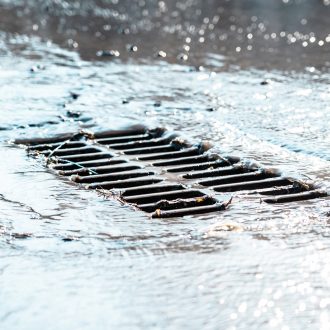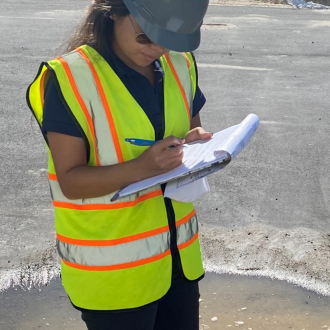

The goal of staying in compliance with NPDES permitting for industrial businesses is to minimize and eliminate pollutants in stormwater runoff. When stormwater runoff comes in contact with pollutants and leaves a site it can be harmful to our waterbodies. A key to achieving compliance is to know where the water leaves from the site. Are you unsure how to find the discharge point? Grab your raincoat and walk the site to find the locations! Walking the site while it is raining can help determine where runoff water is gravitating to. The areas where storm water runoff leaves the facility property is known as an outfall. Swales, ditches, drains,MS4s, and ponds are all areas where storm water will travel to during rain events and should be identified on your facility site map, which should be included in your SWPPP(Stormwater Pollution Prevention Plan). Inspecting the boundary of your site is also important to help identify outfalls not seen onsite.
If the runoff drains to a storm inlet or catch basin outside of your facility, determine the municipal separate storm sewer system MS4. A MS4 is a publicly owned system of conveyances (i.e. roads with draining systems, municipal streets, gutters, ditches, storm drains, swales, or catch basins) that eventually drains into water bodies throughout the United States without treatment. Therefore, it is important to implement a SWPPP plan and continuously monitor your site to ensure potential pollutants do not make it into our local water ways. Drainage areas for each discharge point should be determined and labeled on the site map as well. Knowing the area of each outfall is beneficial when water sampling indicates pollutants at a specific outfall.
KCI is dedicated to helping your industrial facility maintain environmental compliance by offering several services including preparing a site specific SWPPP, assisting with the NPDES storm water permitting, completing routine facility inspections, collecting quarterly visual assessments plus additional water sampling, and providing staff training. We are available to answer questions or concerns and are here to help!